What Is the Best Soil Amendment for Sod in Fairmont MN?
- Mar 4
- 11 min read
Fairmont, Minnesota sits at the intersection of agricultural prosperity and challenging soil conditions. The region's farmland produces abundant crops, yet residential lawns often struggle with the same heavy clay soils, compaction issues, and drainage problems that farmers battle. When homeowners invest in sod installation, whether for new construction or lawn renovation, soil quality determines success or failure more than any other factor. Understanding which amendments transform Fairmont's native soil into sod-ready growing medium protects your investment and ensures lasting results.
Southern Minnesota's soil profile, shaped by glacial activity and thousands of years of prairie grassland, creates specific challenges for turf establishment. The clay content that makes area farmland productive also makes residential lawns difficult. Without proper amendment, sod laid over Fairmont's native soil struggles to root deeply, drains poorly during wet periods, and becomes concrete-hard during summer droughts. Strategic soil improvement before sod installation solves these problems permanently.
Understanding Fairmont's Native Soil Conditions
Martin County, where Fairmont is located, features primarily Clarion-Nicollet-Webster soil associations. These soils developed under prairie vegetation with high organic matter content in topsoil layers. However, residential construction strips away this valuable topsoil, exposing denser subsoil with high clay content and reduced organic matter. The result is challenging growing conditions that demand correction.
Clay soils dominate Fairmont's residential areas. These fine-textured soils contain particles smaller than 0.002 millimeters that pack together tightly. When wet, clay becomes sticky and unworkable. When dry, it hardens into concrete-like consistency that cracks and resists water penetration. Grass roots struggle to penetrate compacted clay, creating shallow root systems that suffer during stress periods.
Drainage issues plague many Fairmont properties. Clay's slow permeability means water moves through soil at glacial rates, literally. During spring snowmelt or heavy rains, water tables rise and surface pooling occurs. Sod installed over poorly drained soil drowns during wet periods despite drought tolerance during dry spells. The alternating saturation and desiccation kills grass more effectively than consistent dry conditions.
Soil compaction from construction equipment, foot traffic, and natural settling reduces pore space that roots need for growth and gas exchange. Fairmont's freeze-thaw cycles temporarily relieve some compaction, but without organic matter addition, soils quickly recompact under weight and moisture. Compacted soils resist root penetration and create perched water tables that suffocate plants.
Nutrient availability varies widely across Fairmont properties. Agricultural lime applications on surrounding farmland influence local pH, often creating alkaline conditions that limit micronutrient availability. Construction debris, including concrete residue and drywall, further alters soil chemistry. Without testing, homeowners cannot know which nutrients require supplementation.
Compost: The Universal Soil Improver
Compost stands as the single most effective soil amendment for Fairmont sod installations. This decomposed organic matter addresses virtually every soil problem common to the region while providing benefits no other single amendment can match.
Organic matter content in compost improves soil structure immediately and long-term. When incorporated into clay soils, compost particles create pore spaces between clay platelets, improving aeration and drainage. These same pores hold water against gravity, increasing moisture availability during dry periods. The result is soil that drains better when wet and retains moisture longer when dry, solving Fairmont's alternating extremes.
Compost introduces beneficial microorganisms that cycle nutrients, suppress disease organisms, and create soil aggregates that resist compaction. Fairmont's native soils often lack biological diversity after construction disturbance. Compost inoculates soil with living communities that continue improving conditions years after installation.
Nutrient availability from compost differs fundamentally from synthetic fertilizers. Rather than soluble salts that flush through soil or burn roots, compost nutrients release slowly as microorganisms decompose organic matter. This steady feeding matches grass growth patterns and reduces nutrient loss to groundwater. The nitrogen, phosphorus, and potassium in compost support sod establishment without the surge growth that weakens plants.
Application rates for Fairmont sod preparation typically range from one to three inches of compost incorporated into the top six to eight inches of soil. For severely degraded construction soils, three inches provides dramatic improvement. For moderately disturbed areas, one to two inches suffices. Spread compost evenly over the prepared surface and till thoroughly to create uniform mixture rather than layered profiles.
Quality compost matters significantly. Mature compost, fully decomposed with earthy smell and crumbly texture, provides immediate benefits without nitrogen immobilization or heat damage. Fresh, unfinished manure or yard waste compost can burn roots, introduce weed seeds, or temporarily tie up nitrogen during critical sod establishment. Source compost from reputable suppliers with testing documentation showing stable, mature product free from contaminants.
Topsoil: Building the Root Zone
While compost improves existing soil, quality topsoil adds new growing medium that creates ideal root zones for sod establishment. For Fairmont properties with severely degraded or thin soil profiles, topsoil addition provides necessary depth for healthy root development.
Black dirt, the prairie topsoil that originally covered this region, offers ideal characteristics for turf growth. High organic matter content, granular structure, and biological activity create perfect conditions for grass roots. However, true black dirt becomes increasingly scarce and expensive as development consumes agricultural land. Most available topsoil represents blended or screened
products rather than native prairie soil.
When selecting topsoil for Fairmont sod projects, examine texture and composition carefully. Ideal topsoil contains approximately forty-five percent mineral material, twenty-five percent water, twenty-five percent air, and five percent organic matter. It should feel friable when moist, neither gritty like sand nor sticky like pure clay. Request soil test results showing pH between six and seven, organic matter above three percent, and absence of contaminants.
Application depth depends on existing conditions. For new construction sites scraped to subsoil, four to six inches of topsoil creates adequate root zone for sod. For lawn renovation projects with thin but viable existing soil, two to three inches of topsoil amendment improves conditions without creating layered interfaces that impede root penetration. Spread topsoil evenly and till lightly into existing soil to prevent distinct layers.
Blending topsoil with compost often provides optimal results. A fifty-fifty mixture combines topsoil's volume and mineral content with compost's biological activity and structure improvement. This approach stretches amendment budgets while delivering superior results compared to either material alone. For Fairmont's challenging clay soils, this blended approach proves particularly effective.
Sand: Improving Drainage with Caution
Sand amendment appeals to homeowners struggling with poorly drained Fairmont lawns. The logic seems sound: sand improves drainage in clay soils. However, improper sand application creates worse problems than original clay conditions.
The "brick mortar" effect occurs when sand mixes with clay in incorrect proportions. Clay particles fill spaces between sand grains, creating dense, concrete-like material that drains worse than original clay. This happens when sand application rates are too low or mixing is inadequate. The result is permanent soil damage requiring complete removal and replacement.
Successful sand amendment requires specific conditions and techniques. Coarse sand, with particle sizes between 0.1 and 2.0 millimeters, works better than fine sand or masonry sand. Application rates must achieve approximately fifty percent sand in the final soil mixture, requiring several inches of sand incorporated deeply. Thorough mixing prevents layering and ensures uniform texture.
For most Fairmont residential sod projects, sand amendment proves unnecessary and risky. Compost and topsoil amendments improve drainage adequately without brick mortar risks. Reserve sand amendment for severely compacted areas with professional soil testing and engineered application rates. Golf course construction techniques using sand-based root zones require specialized equipment and expertise beyond typical residential installation.
Peat Moss: Acidic Organic Option
Peat moss, harvested from ancient bogs, provides organic matter with unique properties that suit specific Fairmont soil conditions. This amendment acidifies soil while improving water retention and structure.
Acidic pH makes peat moss valuable for Fairmont areas with alkaline soils. When soil tests reveal pH above 7.5, common in areas with agricultural lime history or construction debris, peat moss amendment helps lower pH toward grass-optimal ranges. The acidifying effect is modest and gradual, avoiding dramatic pH swings that shock plants.
Water retention capacity exceeds compost, with peat moss holding twenty times its weight in water. For Fairmont lawns with sandy subsoils or excessive drainage, peat moss amendment increases moisture holding capacity. However, for typical clay soils, this water retention can exacerbate drainage problems rather than solve them.
Sustainability concerns increasingly influence peat moss recommendations. Harvesting peat releases carbon stored for millennia and damages unique wetland ecosystems. Compost provides similar benefits without environmental costs, making it preferred for most applications. Reserve peat moss for specific pH adjustment needs where sulfur or other amendments prove impractical.
Application rates for peat moss are lower than compost due to expansion when wet. Two to three inches of loose peat moss incorporated into soil provides adequate amendment without creating waterlogged conditions. Pre-moistening peat moss before application prevents hydrophobic surface crusting that repels water.
Specialized Amendments for Specific Problems
Beyond universal improvements from compost and topsoil, specific soil problems require targeted amendments.
Gypsum addresses sodium-affected soils without changing pH. Fairmont's road salt exposure and some well water sources create sodium buildup that destroys soil structure. Gypsum calcium replaces sodium on soil particles, allowing sodium leaching and structure restoration. Apply gypsum based on soil testing recommendations, typically one to two pounds per hundred square feet for moderate sodium problems.
Sulfur lowers soil pH when alkalinity limits nutrient availability. Elemental sulfur requires months to oxidize and acidify soil, so apply well before sod installation. Aluminum sulfate works faster but requires careful handling. For Fairmont soils with pH above 7.5, sulfur amendment creates favorable conditions for nutrient uptake. Apply according to soil test recommendations, typically one to three pounds per hundred square feet depending on initial pH and desired reduction.
Lime raises soil pH when acidity limits growth. While less common in Fairmont's alkaline-prone soils, some wooded areas or heavy fertilizer histories create acidic conditions. Agricultural lime or pelletized dolomitic limestone corrects acidity over several months. Apply based on soil testing, with typical rates of five to ten pounds per hundred square feet for moderate acidification.
Mycorrhizal inoculants introduce beneficial fungi that form symbiotic relationships with grass roots. These fungi extend effective root surface area, improving water and nutrient uptake in challenging soils. For Fairmont's disturbed construction soils lacking biological activity, mycorrhizal inoculation accelerates establishment and improves drought tolerance. Apply as powder or liquid according to product instructions, typically during final soil preparation before sod installation.
The Amendment Application Process
Proper application technique ensures amendment benefits reach sod roots rather than remaining on the surface.
Soil testing precedes all amendment decisions. Collect samples from six to eight locations across the sod installation area, mixing thoroughly for composite representation. Test for pH, organic matter, nutrient levels, and texture classification. Local University of Minnesota Extension offices provide testing services with recommendations specific to turf establishment.
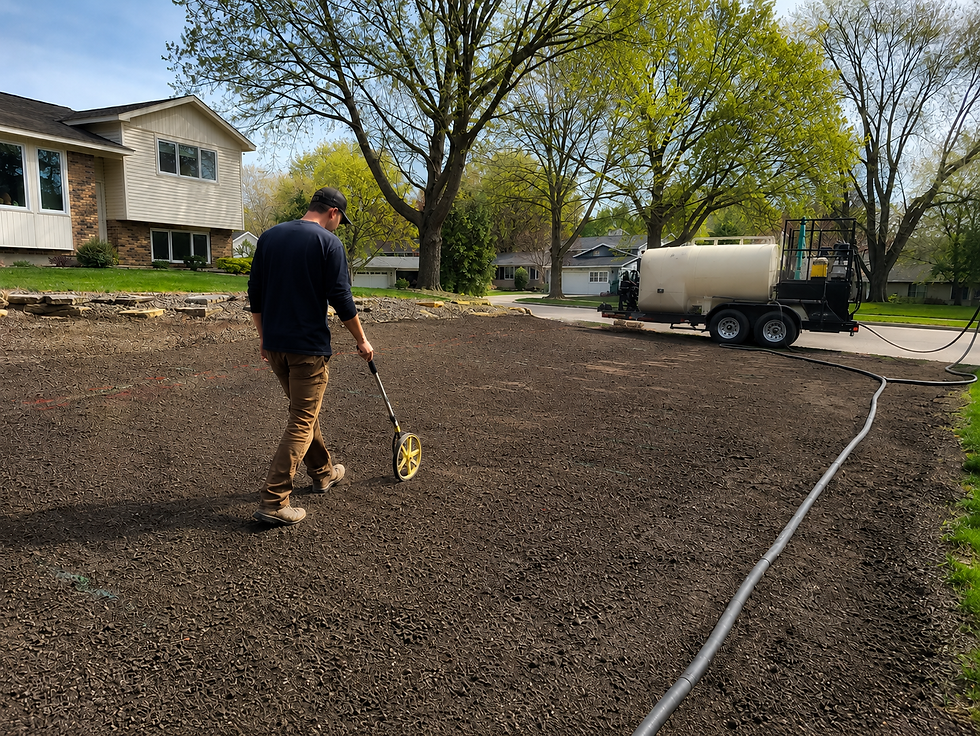
Site preparation removes existing vegetation, construction debris, and large rocks. For lawn renovation, kill existing grass with glyphosate and remove dead material. Rough grading establishes proper surface drainage before amendment application, as amendments cannot correct severe grade problems.
Amendment calculation determines quantities based on area and desired depth. For one thousand square feet with two inches of compost incorporation: one thousand square feet times 0.167 feet depth equals 167 cubic feet, or approximately six cubic yards. Order slightly extra to account for spreading irregularities and compaction.
Application spreads amendment evenly over prepared soil. Use wheelbarrows and shovels for small areas, or tractor-mounted spreaders for large projects. Rake to uniform depth, checking frequently with a ruler or marked stick. Uneven application creates variable growing conditions that show as sod quality differences.
Incorporation mixes amendment thoroughly with native soil to the planned depth. Tillers work for small to medium areas, creating uniform mixture without stratification. For large projects, tractor-mounted tillers or disc harrows achieve efficient blending. Till when soil moisture allows crumbling, not when sticky or powder-dry.
Final grading follows amendment incorporation, creating smooth surface ready for sod. Roll lightly to settle soil and reveal soft spots requiring additional filling. The finished surface should be firm enough to support foot traffic without sinking, yet loose enough to allow root penetration. Slope gently away from structures for drainage.
Cost Considerations for Fairmont Projects
Amendment costs vary widely based on material selection, application rates, and project scale.
Compost typically costs twenty to forty dollars per cubic yard in Fairmont, with delivery fees for smaller orders. For a one-thousand-square-foot lawn with two-inch application, six cubic yards costs one hundred twenty to two hundred forty dollars plus delivery. Bulk purchasing reduces per-yard costs for large projects.
Topsoil prices range from fifteen to thirty dollars per cubic yard depending on quality and screening. Premium black dirt commands higher prices, while blended products offer budget alternatives. Delivery fees apply for orders under minimum quantities, often five to ten yards.
Professional installation including soil testing, amendment calculation, application, and incorporation typically adds one to two dollars per square foot to sod installation costs. For Fairmont's challenging soils, this investment proves essential for long-term success rather than optional upgrade.
DIY amendment reduces costs but requires equipment rental and physical labor. Tiller rental costs forty to eighty dollars daily, while delivery fees for materials may exceed professional wholesale pricing. Evaluate total costs including time value when deciding between DIY and professional amendment.
Frequently Asked Questions
What is the best soil amendment for sod in Fairmont MN?
Compost provides the best overall improvement for Fairmont's clay soils, addressing drainage, aeration, nutrient availability, and biological activity. Quality compost incorporated two to three inches deep transforms native soil into sod-ready growing medium.
How much does soil amendment cost for sod installation?
Professional soil amendment adds one to two dollars per square foot to sod installation costs. DIY amendment with compost costs approximately twenty to forty cents per square foot for materials, plus equipment rental and labor.
When should I amend soil before sod installation?
Complete soil amendment two to four weeks before sod installation when possible. This allows soil settling and initial biological activity. However, amendment immediately before sod laying succeeds when necessary, particularly with mature compost.
Can I install sod without soil amendment?
Sod installed over unamended Fairmont clay soil often struggles with drainage, rooting, and long-term health. While possible, amendment dramatically improves success rates and reduces future maintenance and replacement costs.
How deep should soil amendment go for sod?
Amend soil six to eight inches deep for sod installation. This depth accommodates grass root systems and provides lasting improvement. Shallow amendment creates a shallow root zone that suffers during drought and temperature extremes.
Does sand improve clay soil for sod?
Sand improves clay soil only when applied at high rates, approximately fifty percent by volume, and thoroughly mixed. Lower application rates create dense, concrete-like soil. Compost amendment provides better results with lower risk for most Fairmont projects.
How do I know if my soil needs amendment?
Soil testing reveals pH, organic matter, nutrients, and texture. Visual indicators including poor drainage, hard surface crusting, sparse vegetation, or standing water after rain suggest amendment needs. Construction sites almost always require amendment.
What pH should soil be for sod installation?
Ideal soil pH for turfgrass ranges from 6.0 to 7.0. Fairmont soils often test alkaline, above 7.0, requiring sulfur or peat moss amendment. Extremely acidic soils below 6.0 need lime application several months before sod installation.
Can I use fresh manure as soil amendment?
Fresh manure burns grass roots, introduces weed seeds, and creates nitrogen immobilization that starves establishing sod. Use only mature, fully composted manure, or apply fresh manure six months before sod installation with thorough incorporation.
How does soil amendment affect sod watering requirements?
Amended soil retains moisture more effectively while draining better, reducing watering frequency but maintaining adequate supply. Establishment watering remains critical, but amended soils resist both drought stress and waterlogging compared to unimproved clay.
Should I amend soil for sod or seed differently?
Amendment principles remain similar, but sod installation tolerates less prepared soil because mature grass handles stress better than seedlings. However, proper amendment benefits both establishment methods significantly, particularly in Fairmont's challenging soils.
What is the biggest mistake in soil amendment for sod?
Inadequate incorporation depth and poor mixing create stratified layers that impede root penetration. Surface application without tillage provides minimal benefit. Thorough mixing to six to eight inches depth ensures amendment benefits reach sod roots
Ready to ensure your Fairmont sod installation succeeds from the ground up? Mankato Sod & Hydroseed provides comprehensive soil amendment services that transform challenging southern Minnesota clay into thriving lawn foundation. Our experts test your soil, recommend appropriate amendments, and properly prepare your site for lasting sod performance. We understand that great lawns start with great soil, and we deliver the preparation expertise that protects your investment through Fairmont's challenging freeze-thaw cycles and variable moisture conditions. Contact Mankato Sod & Hydroseed today to schedule your soil assessment and discover how proper amendment makes the difference between struggling turf and a lawn that thrives for years.
Mankato Sod & Hydroseed: https://www.mankatosodandhydroseed.com/


Comments